
Therecord.
The ride from the seat, the four conversations at every board table, the stories from the minutes and the routing office, at full length.
What the ride costs the student
Before it is a line in the budget, it is an hour of a child's morning. This chapter is about the students with IEPs who ride the longest, the students with no fixed address who ride beside them, and the people who have to decide who waits.
Erin Andrews rode a school bus for the first time in sixth grade, her first year in public school. She uses a power wheelchair, so she could not ride the bus her sisters took, the one that picked them up a lot later. She waited outside in the dark for her own.1 Years later, writing as a rehabilitation psychologist and a parent, she described the ride in a sentence most adults who took it will recognize: "I hated being the first to get on and the last one off and having to ride around the entire county picking up and dropping off all of the other kids with disabilities."1
That sentence is the chapter before the cost chapter. Every number in the paper, the $13,825 seat, the 59 routes with one student, the 15 students in Monterey County with no bus, lands on a child who is first on and last off. The sections below follow the ride from the curb: what the time costs, what it feels like, who has to decide, and the students who ride with no address at all.
The research on bus rides points one direction, with a gap in it. In Michigan, economically disadvantaged students who qualified for a bus were 20% less likely to be chronically absent than near-identical students who lived just inside the walk zone.2 In California, 27.7% of students with disabilities were chronically absent in 2024-25 against 19.4% of all students, and the state's own analysts list transportation among the causes.34 Neither dataset singles out the students with the longest rides: the riders with the longest trips are the ones no dataset follows. The clearest numbers come from the places that were forced to publish them. In Chicago in 2022, 365 students with disabilities had commutes over 90 minutes while 1,200 more students with disabilities or in temporary housing waited for any route at all.5 In North Carolina, a records request after the state found Wake County had violated two students' IEPs turned up more than 16,000 informal transportation complaints in six years.6 In most districts the number exists only in the transportation office's phone log.
I couldn't ride the same bus my sisters took (which picked them up a lot later, by the way); I rode the short bus.Erin AndrewsRehabilitation psychologist, parent advisor to the Disabled Parenting Project, and a short bus rider from sixth gradeDisabled Parenting Project, Apr. 20161
A 3-year-old with autism was scheduled for a 6:55 a.m. pickup for an 8:30 start, a ride the local station put at nearly two hours. She missed the first six days of her preschool program. The county's contracted carrier had just changed owners and its phone was disconnected; a former driver alleged expired car seats and the county audited them.7
The county recommends that routes stay under 90 minutes each way and requires the carrier to tell it when one runs longer. Her ride was capped at an hour after her family provided medical documentation. The fix arrived the way it usually does: after a parent, a reporter and a physician each spent part of a week on it.7
From the seat, and from the people who drive it
At the end of the day it is transportation for special education students. If parents choose to select transportation, we're required to provide it. But now we're down three routes.Monterey County Office of Education, California, to the county board after three of its 13 drivers left in one summer. Aug. 20268
The idea behind this is to reduce route times, as we have many students that are on the bus more than 60 minutes in order to get to the school or the program that they attend.Apple Valley Unified School District, California, asking its board for more special education routes. Sept. 20269
Consistency is so important for these children, and having that same driver. You take a driver and you don't have them on that route that day, that might trigger that child to have a behavior, because they're so used to seeing you.A driver trainer for Springfield, Massachusetts' bus contractor, who trains its special needs drivers, to the School Committee. Sept. 202610
The system makes these decisions impossible. The people still have to make them.
In January 2022 Chicago Public Schools had 500 of the 1,200 drivers it needed for 20,000 bus riders, half of them students with disabilities, and 631 students with IEPs still had no route. The board voted unanimously to take buses away from magnet and selective enrollment students if the problem was not solved by the end of February, so that students whose IEPs required a ride would get one.11 Nobody at that table was failing to care. They were choosing which group of children would wait, with the only lever they had.
That is the shape of the decision wherever the shortage lands. The Chester County, South Carolina director with 114 runs and five attendants decides each morning "who can do without an attendant on that particular run."12 A preschool teacher in Chicago told her board in 2024 what the wait had already cost one of her students, while 1,099 students with disabilities were still unrouted as of Sept. 23.13 The transportation office is where a federal right meets a driver list, and the people in it are asked to make the arithmetic work with their own hands.
The law gives them no out. Julie Weatherly, a special education attorney with 40 years in the field, told the TSD Conference in November 2026 that the absence of a driver, an aide or a nurse generally does not remove a district's obligation to provide a required service, and warned against basing decisions on staffing, scheduling or administrative convenience instead of the student's documented needs.14 Tennessee's education department told its districts the same thing in 2023: "The IDEA does not have any provisions that alter FAPE requirements during widespread staffing shortages."15 The shortage is real. The obligation does not bend to it, which is why the fix has to come from the route.
The staff are not the problem. The shortage, the contract and the missing data are the problem. Every move in the paper's playbook is about giving the people at that table a better set of choices than "who waits."
We have a legal and moral responsibility as the board to serve those who are most vulnerable. I wish it will not come to this, to having to make a choice between general ed students and students [in special education]. But with a heavy heart, I fully support the resolution.Luisiana MeléndezMember, Chicago Board of Education, voting to move buses from magnet students to students with disabilitiesChicago Sun-Times, Jan. 202211
This student with disabilities will never get back the first five weeks of preschool, the community-building, the learning of routines, the bonding with friends and teachers.Kirsten RobertsPreschool teacher, Brentano Elementary, to the Chicago Board of EducationChalkbeat Chicago, Oct. 202413
There was no reason why we should have kids on a bus for more than an hour. Anything over an hour, it's just, it's just too much, obviously.Miguel del VallePresident, Chicago Board of Education, after 365 students with disabilities were found riding more than 90 minutesChalkbeat Chicago, Aug. 20225
The students with no address, and the one thing that stays the same
Public schools identified 1,548,191 students experiencing homelessness in 2023-24, up 28% in two years. Their four-year graduation rate was 70.1%, and 47.7% of them were chronically absent.16 The word homeless brings a picture to mind that is mostly wrong: about three in four of these students are doubled up, living with relatives or friends after losing their own housing, and most of the rest are in shelters or hotels.16 What they have in common is that the address changes and the school, under McKinney-Vento, does not have to. The district has to get them there, across district lines if necessary, and students in foster care have the same right under ESSA.17 19.5% of homeless students also have an IEP.16 The bus is often the one piece of the day that stays the same.
In small districts these obligations arrive one student at a time. A Washington district told its board that transporting fewer than 50 McKinney-Vento students "probably hits into the hundreds of thousands of dollars" because a bus may carry two or three of them to a neighboring town.18 Isle of Wight County, Virginia found its McKinney-Vento count up 103% in a year.19 Virginia Beach moved $420,000 mid-year to cover the growth.20
When the ride does not come, the numbers move fast. In California, 34.9% of homeless youth were chronically absent in 2024-25, a rate exceeded only by foster youth among the groups the state reports.34 In Nashville, the district found chronic absenteeism among students experiencing homelessness running at more than double the housed rate, and transportation was the most commonly cited barrier to attendance.21 In Grapeview, Washington, a small district on Hood Canal, an administrator described to the board what happens when a McKinney-Vento student needs a ride: "Usually, we get on the phone, we all know that we have to do it, and we're like, can you do it? Can you do it?" Sometimes nobody can, "so we contract with a private driving company, which is very expensive."22 The liaisons who hold these cases say the same thing from three different states: the law is generous, the capacity is not.
For many of our families, school is their sense of security.Scott West, who handles McKinney-Vento cases for Moses Lake School District, Washington. Columbia Basin Herald, Mar. 202623
In theory and on paper, we have a lot of resources. But they are maxed out.Ema Lyman, McKinney-Vento liaison, Boulder Valley School District, Colorado. Chalkbeat Colorado, Apr. 202324
It's terrifying. All of it keeps me up at night.Susie Terry, coordinator for homeless education services, San Diego County Office of Education, where districts have identified more than 23,000 students experiencing homelessness. NPR, May 202525
Nobody measures the ride
Every state in the rulebook tracks what it reimburses. We could not find one that publishes, as a matter of course, how long students with IEPs ride or how often their bus is late. Wake County's numbers exist because the state investigated. Chicago's exist because a reporter requested the routing data. Schenectady's exist because a mother called a television station. The ride is the one output of this system nobody is required to report, and it is the only one the student feels.
That is why the paper spends its back half on routing. The accommodations are set by law and should be. The ride is set by whoever builds the route, with whatever data they have, and that is the part a district can change this semester. Where you live shouldn't determine how you learn. Neither should the bus.

The geometry is different
A chain of houses instead of a chain of corners, on a calendar that is written all year, with stops that cannot go on a public map.
A general education route is a chain of corner stops with 50 students aboard. A special education route is a chain of houses. In School Bus Fleet's surveys, 72% to 90% of special needs stops are school-to-home.2627 When Chalkbeat analyzed Chicago's routing data in late 2023, Chicago Public Schools was running more than 1,000 routes for 7,350 students with IEPs to 540 schools: an average of 6.9 students per route, 785 routes with 10 or fewer, and 59 routes carrying one student.28 The district's explanation: "distance, medical equipment, and/or required bus aides that will require less students in the vehicle."28
Load time is the other geometry. One Washington district's labor contract adds seven minutes for each wheelchair stop, plus a minute each for a safety vest or car seat. A California district adds up to 20 minutes at two schools for traffic and wheelchair loading.29 Those minutes are real, and if they are not in the route they are in the ETA parents see and in the driver's paid time. One Arizona assistant director rebuilding 56 routes by hand this fall put it simply: in other platforms she has used, a wheelchair or harness designation automatically adds time at the stop, and without it "it is slow and easy to miss as routes change."29 The BusRight Solutions team builds the buffer into the stop today; automatic per-student lead time is on the product roadmap.29
The calendar fights back too. Sonoma County's transportation agency listed its 2026-27 cost drivers in one budget: special needs ridership up 26% since 2022-23, six new aides "based on IEP requirements since December 2025," more midday shuttles for modified school days, and member districts and non-public schools whose extended school year, spring breaks and early releases do not line up.30 IEPs are written all year: a mid-year placement added $116,000 to Westport, Massachusetts' budget after it was adopted, and Brookfield's did the same.3132
Privacy cuts against the parent app. McKinney-Vento and foster care stops are addresses, and an address in a parent app can identify a family. A Michigan district found parents posting the mystery stops on Facebook and other parents guessing in the comments which students were homeless.29 Several districts now keep special education and McKinney-Vento routes out of the parent-facing map entirely, which is what districts in Washington and Arizona chose after thinking about who else could see the stop.29 None of this is news to the people who do it: in BusRight's own survey of California transportation leaders before the 2026 CASTO conference, the most-cited routing challenge was "meeting complex special education transportation requirements," and balancing efficiency against ride-time limits tied for third.33

Board minutes from 2025 and 2026 show the same four conversations in every region
Every example is a real meeting, with a date.
The mid-year surprise
Nashoba Regional in Massachusetts budgeted about $4.5 million for out-of-district placements and $2.4 million for specialized transportation. By October 2026 the committee was looking at a $1.7 million gap, with tuition up more than 30% and the district's entire circuit breaker balance spent. Superintendent Kirk Downing: "even changes in our scenarios with new students coming in as well as changes to IEPs has resulted in significant increases in costs."36
Hampton, New Hampshire runs four in-district buses and three out-of-district placements; its special needs transportation line is $570,650 and one of the placements costs $160,000 in transportation alone. A board member's reaction is in the record: "Wow, $160,000 for one out of district placement... And that's just the transportation."37 Westport, Massachusetts added $116,000 for a single student who moved in after the budget passed.31 A North Branford, Connecticut board member learned at a contract vote that there was "an additional $200,000 for special ed transportation" nobody had mentioned.38 Tuxedo, New York discussed drawing on fund balance mid-year because "special ed items are mandated by federal law."39 The bigger picture is the same: Minnesota's statewide special education transportation bill grew from $181 million in fiscal 2014 to $334 million in fiscal 2024, up 84% while the number of riders grew 19%; Ohio reported $285.7 million for fiscal 2023; New Hampshire isolated $75 million in a single year.404142 Natick's budget slide for fiscal 2027 says it plainly: "Special Ed Transportation: est. 6% increase; possibly changing vendors to stay within budget."43
Contract it out, or bring it back
Garvey, a K-8 district of about 4,000 students in California, carries about $1.97 million in purchase orders across three alternative transportation vendors for IEP and McKinney-Vento students. One rate card is itemized: a $48 trip fee, $2.50 a mile with a four-mile minimum, $50 per wheelchair student, $35 an hour for a monitor, $15 per 15 minutes of wait time, and a no-show billed at the full trip.44 Centralia's renewal recorded the base rate rising $11 to $50 a ride.45 Alhambra's RFP addendum told bidders the current providers are two rideshare companies and the contract is worth about $250,000 a year.46 California does not publish a per-rider figure, and its reimbursement formula does not separate the two: since 2022-23 the state has paid districts 60% of their prior-year home-to-school transportation spending, special education included.47
The other direction is in the minutes too. Riverside Local in Ohio found 16 students on private van contracts at up to $320 per student per day and cut the count to five in a year by using district vans, sibling discounts and parent contracts.4849 Cleveland Heights-University Heights was paying "a little over $26,000 a month" to two van companies to carry 24 to 30 students to its own schools, and bought three vans to recapture them.50 Lorain is ending a decade of contracted special needs and homeless transportation and expects to save about $1 million a year.51 Berkeley Heights, New Jersey is hiring a dedicated special education van driver to stop paying a county commission.52 The national numbers point the same way: in School Bus Fleet's fall 2026 district survey, 45% of districts said they use an alternative transportation provider, down from 56% a year earlier, while 43% run their own vans or non-bus vehicles and 42% reimburse parents for mileage.34
The reasons districts give are not only cost. A driver trainer for Springfield, Massachusetts' bus contractor told the school committee that a substitute on a special needs route "might trigger that child to have a behavior," and the contractor itself said spare drivers "don't know these routes," which "leads to delays for the families."1053 In Brownfield, Maine, an out-of-district student never arrived at school one December morning. The district cancelled the contract, and the replacement requires GPS, audio and video on every out-of-district vehicle, independent background checks for drivers and substitutes, and English proficiency for every driver.54 A transportation director in one BusRight district told the BusRight Solutions team this fall why she is buying vans instead: the vendor sends a different driver most days, the drivers and her students often cannot talk to each other, so a long ride is a long ride with a stranger, and a district van driven by a staff member without a CDL costs her less.29 East Windsor, Connecticut did that math on one special education program run: a contract of about $100,000 a year that rises every year, against a district van driven by the job coach and transition coordinator who already know the students, for a saving of "just over $50,000."55 Carpinteria, California keeps five vans it "frequently uses for special education" and replaced the one with 182,000 miles rather than repair it.56 Stevens Point, Wisconsin runs two lift-equipped Ford Transits "driven by non-CDL drivers."57 Nobleboro, Maine's board, approving vans mostly for special education, asked what it had cost to transport one child for a year and called the vans "the biggest cost savings."58
Neither direction ends the district's responsibility. At the TSD Conference in November 2026, Tennessee's state director of student transportation, Joshua Hinerman, said the district stays accountable for a student's safety when a contractor drives, and Kenny Mulder, who runs about 60 alternative transportation routes through four companies for the Special School District of St. Louis, described RFPs that require driver licensing, motor vehicle record checks and criminal background checks, the terms Brownfield wrote in after its student never arrived.5954 Launi Harden, a retired Utah transportation director who now runs Florida's pupil transportation association, put the standard in one line: "You don't lower your standards when you bring a partner in."60
For scale, the BusRight Solutions team's rule of thumb is that one in-house route costs a district about $80,000 a year in wages, benefits, fuel and maintenance, and a contracted route on the East Coast runs $80,000 to $110,000.29 Riverside's board compared its $312-a-day van rate to the $58-a-day Medicaid transport rate a board member sees in her own work.48 Nashoba estimates it saves about $100,000 a year by employing a $75,000 to $85,000 coordinator instead of paying an 8% agency fee.63
The aide seat is the hardest to fill
Chester County, South Carolina runs 114 routes with five special needs attendants. Its director asked the board for one more because "when we have absence, we don't have a spare person to put on those special needs buses... it's becoming more challenging and challenging for me to determine who can do without an attendant on that particular run."12 Garrett-Keyser-Butler, Indiana had to open a new special needs route when its co-op moved programs; it hired the monitor and started school still looking for the driver.67 Monroe, Connecticut cut safety monitors to balance a budget and confirmed the five assistants on special needs runs could not go, because "those special needs runs... need an assistant on there."68 Nationally, 72% of operators report the driver shortage affecting their special needs routes, and nearly two thirds now staff an aide on every special needs bus.2769
Why the seat stays empty. Running Short covered why drivers are hard to hire. The aide seat is harder, and the reasons are plainer. Start with pay: Henry County, Georgia raised starting pay for bus monitors to $14.40 an hour in 2021.70 A Laramie, Wyoming paraeducator who works two other jobs put the competition in one line, "We are losing people to Burger King," and the state school boards association said fast food in parts of Wyoming pays $16 to $18 an hour. The same aide described being "hit, bit, bruised, kicked" and a pencil through her hand that she paid to treat herself, because injuries caused by students are not covered by workers' compensation.71
What has worked. East Windsor, Connecticut put its special education van in the hands of staff who already know the students, a job coach and a transition coordinator with the endorsement to drive it.55 Converse County, Wyoming lets eligible drivers retire, collect their pension and come back on the payroll.71 Who could fill the seat. The CPR, first aid and medical requirements and the split shift fit people who already work that way: nursing assistants, EMTs, home health aides, retirees, and nursing and education students. That is a hypothesis from the BusRight Solutions team, whose analysts include a former special education aide, not a finding from the sources, and it is worth testing in your own hiring.29
The other question is whether every seat needs filling. Patrick Mulick, the autism coordinator for Washington's Auburn School District, opened the 2026 TSD Conference on what he called an over-reliance on 1:1 adults: "If there is no plan to remove the training wheels, then you are only training the child to be dependent on them."72 Michael Giangreco at the University of Vermont found that one-to-one paraprofessional support, an increasingly common model, brings unnecessary dependence, stigma and less contact with peers, and argued that it should be treated as one of the most restrictive supports a team can choose and assigned with a plan to fade it.73 Glenna Wright-Gallo, who ran the federal special education office until 2025, made the routing version of the point in Frisco: an IEP that says only "special transportation" gives the router nothing to work with, and should be reviewed to see whether the student can move to a conventional bus.60
McKinney-Vento rides come out of the same budget
Transportation to the school of origin is required, the cost is split with the other district only if the two agree, and the vehicles are often the same vans and small buses the special education office needs.17
Mid-year transfer "to address increased McKinney-Vento transportation cost from a rise in the number of students being served," with a board member warning the number could rise again before June.20
The board rescinded a two-year rideshare contract for McKinney-Vento rides "in consideration of concerns related to cost" and approved one year instead. The division routed 66 McKinney-Vento students last year.74
The transportation director's McKinney-Vento stipend, doubled for the paperwork: "the work, the leg work, the ensuring that it's an actual McKinney Vento status and all of that is on our end."75
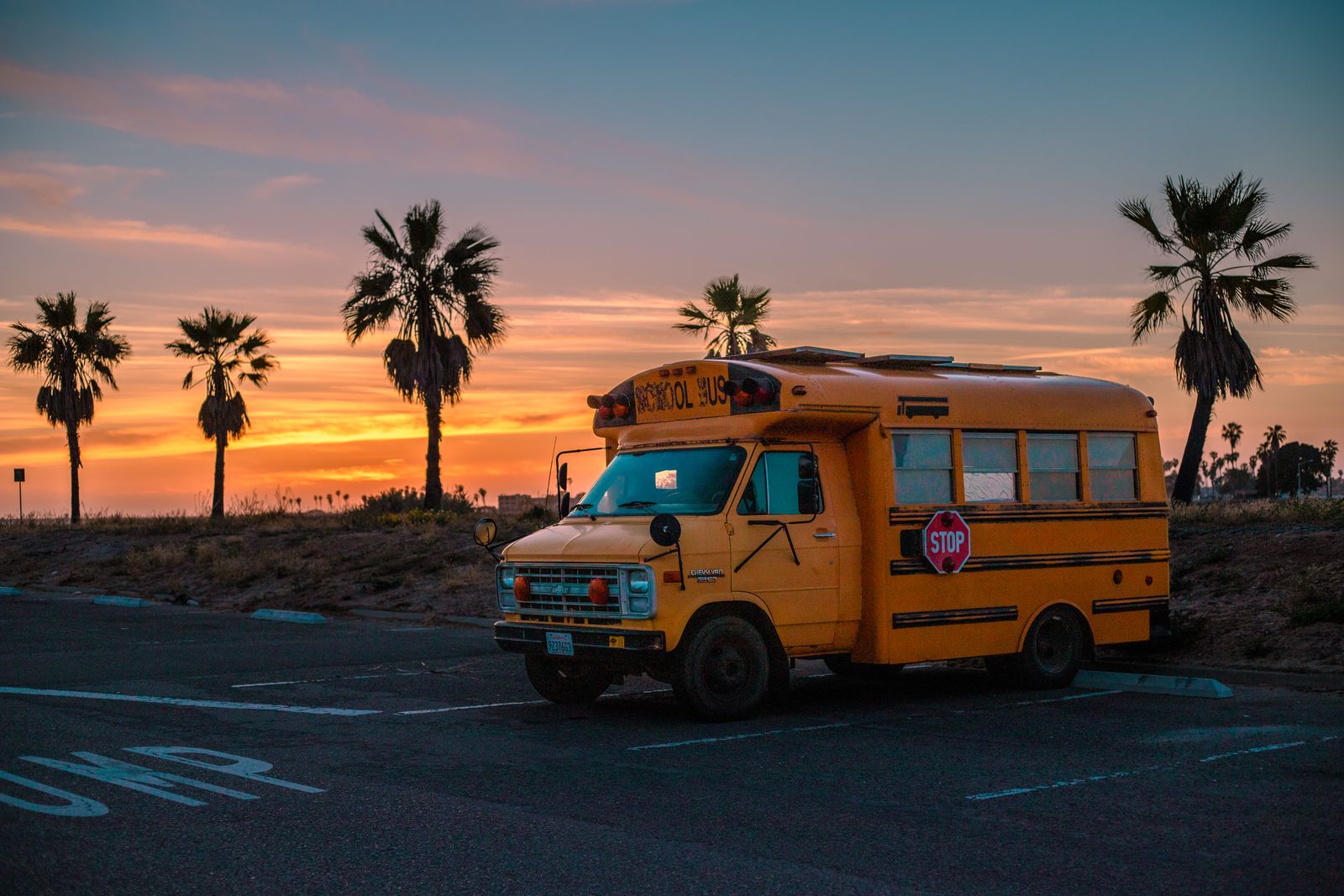
Three more districts, in their own words
The paper carries Riverside and Balsz. These are the others from the minutes.

Sometimes the big contracts on specialized transportation end up being constrictive rather than flexible. So, we're in a flexible place now.
The district left its collaborative's transportation contract, hired its own special education transportation coordinator and now ride-shares with any nearby town instead of running "singletons riding vans." The coordinator rides routes, checks harnesses and buckle guards, and keeps rides short because some students "have a hard time riding some of the specialized vehicles." Estimated saving: about $100,000 a year against an 8% agency fee.63
So, some of our highest need students are also waiting the longest for the bus.
Middle and high school special needs students were last on the single special needs route and the bus was not arriving until 4:30 p.m., with staff paid to wait with them. The board approved a second route, one driver and one monitor. "It costs us one way or the other and you know of course it's hard on the students."76
When we have absence, we don't have a spare person to put on those special needs buses.
42 state-assigned buses, about 114 runs a day, 38 drivers and five special needs attendants. The budget request: one more attendant, three monitors and a routing coordinator, so that no one has "to determine who can do without an attendant on that particular run."12
Inside the routing office
Two more findings from the BusRight Solutions team, on the data that reaches the router and the roster that reaches the driver.
The IEP data arrives on the IEP calendar, not the routing calendar.
The first question in every engagement is the same: is the special education and McKinney-Vento information up to date? When it is, routing 300 students is a day's work. When it is not, the first two weeks of school are spent finding out which bus has the lift.29 A California district that runs only special education transportation, to eight schools, came onto BusRight this fall from paper letters and a spreadsheet; its wheelchair and aide labels are what its drivers and its ETAs now run on.29 The special education office updates its records on an IEP calendar. Ask for the three fields that change routes, equipment, aide and stop type, every semester and at every mid-year placement, and treat the handoff like enrollment.
Give the driver and the aide the roster, and keep the map private.
A substitute on a special education route needs to know who gets off where. An Arizona district running a three-bell day on one bus asked for exactly that: each student's school on the tablet, in stop order, because the driver drops at three schools.29 A sub driver and sub monitor on one special needs route did not know a student was not supposed to carry a bookbag; another district had a non-verbal student get off at the wrong stop.29 On the BusRight tablet the roster carries photos, each student's school and the stop note, and a Safety Pass scan flags a student boarding the wrong bus. Districts that keep route history in the system use it the other way too: a Texas district pulls its logs when an IEP complaint arrives.29
Keep the short runs in-house, and know why.
The board records point the same way as the field: Riverside's 16 van contracts, Cleveland Heights' $26,000 a month, Lorain's decade of contracted rides.495051 A California district where about 85% of riders are in special education lost drivers and went from 12 routes to nine this year; it keeps its own students on its own buses and contracts only the overflow to a vendor and the county office.29 A Massachusetts district with five contracted vans told us this fall it wants its own buses because the contractor "has been frustrating."29 In the 2026 survey, 87% of operators mainstream at least some special needs riders, a record.69 Two thirds of school-age students with IEPs spend 80% or more of their day in general classes, which matters for transportation: in the BusRight Solutions team's experience, the same student who is included in class is often still routed on a separate bus.7729

The ride is set by whoever builds the route
The paper's playbook is eight routing moves a district can make this semester. Bring your rider list, your contracts and your ride times, and we will walk the routes with you.
Also in this series: The rulebook, 2025-26.
Back to top